Parish Recognition · buyer guide
Cast relief versus flat engraved church dedication plaques
For worldwide Parish Recognition orders, compare the proposed relief, lettering and image treatment rather than choosing a church dedication plaque from the words cast or engraved alone. A dimensional emblem and a detailed flat inscription can serve different priorities. Ask for the actual face construction and a representative detail proof before approving either direction.
Reviewed 2026-09-05 · AI-assisted editorial review. General buying guidance; illustrative scenarios are not customer case studies. Images are AI-generated concepts.
Start with the feature the congregation wants people to notice: the building name, a selected emblem, a dedication or an approved historical image. A sculptural focal element can give the face a different character from a relatively flat inscription, but neither is automatically the right choice for every church interior. The Building & Dedication Plaque concept provides the relevant product direction; its final metal and construction remain project-specific. Ask the organizer to identify the essential visual features before discussing a finish. This page concerns how those features are physically represented. It does not replace the congregation’s separate approval of the dedication wording or the installer’s assessment of the actual wall and attachment arrangement.
Does engraved always mean flat and cast always mean raised?
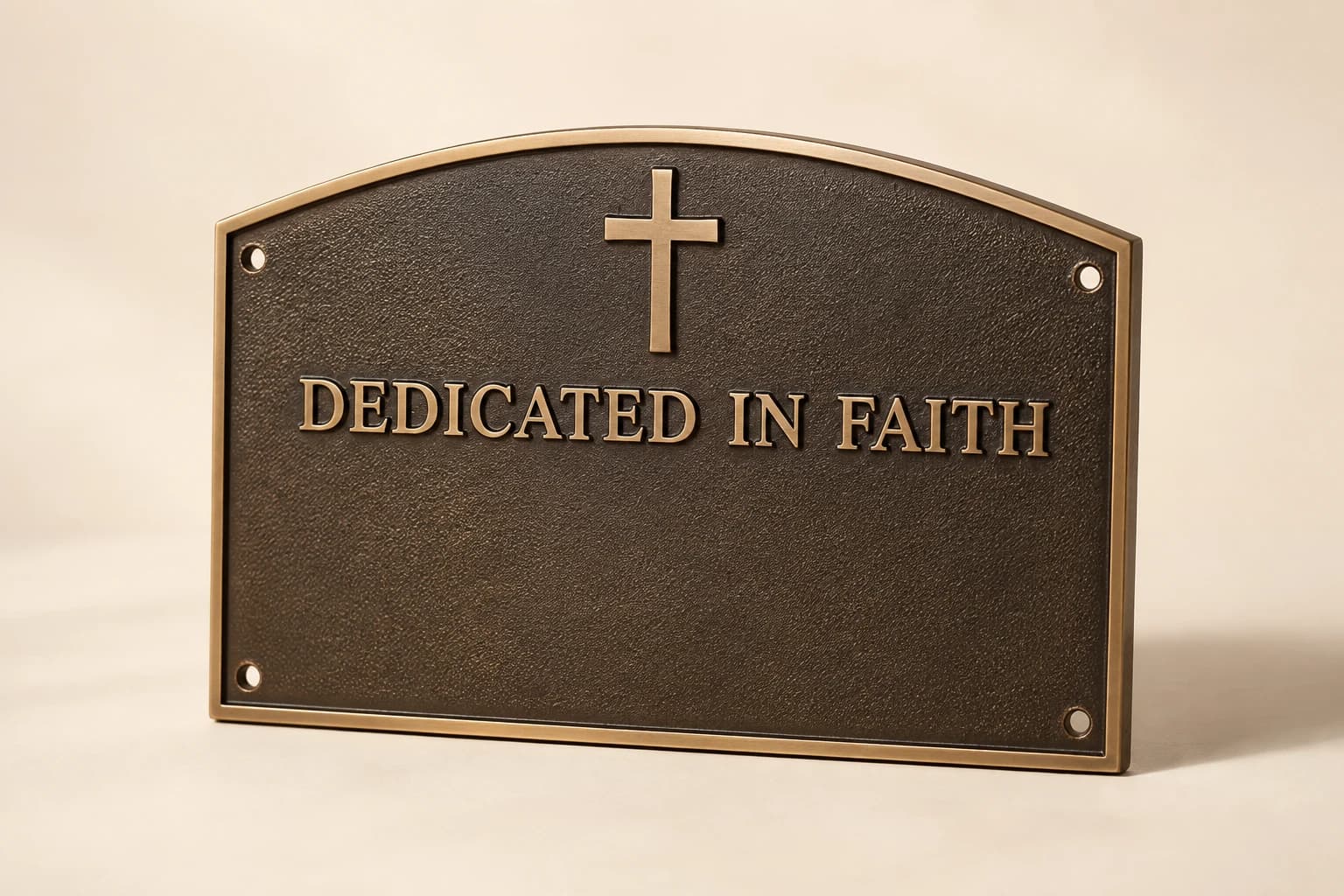
Do not rely on that shorthand to describe the finished face. Ask which text, background and emblem areas are raised, recessed, printed or separately attached in the actual proposal. The method name alone does not explain every surface relationship. A drawing can look dimensional because it uses shadows, even when those shadows are only part of the illustration.
Request a section view, a clear construction description or a representative sample when depth is a central reason for buying. Keep the selected effect separate from a claim about how it is made. This helps the congregation compare what it will see and feel without assuming that a convenient product label guarantees one particular relief treatment.
Gemini describes both raised and recessed graphics within its etched-plaque options.

How should fine architectural or religious detail be reviewed?
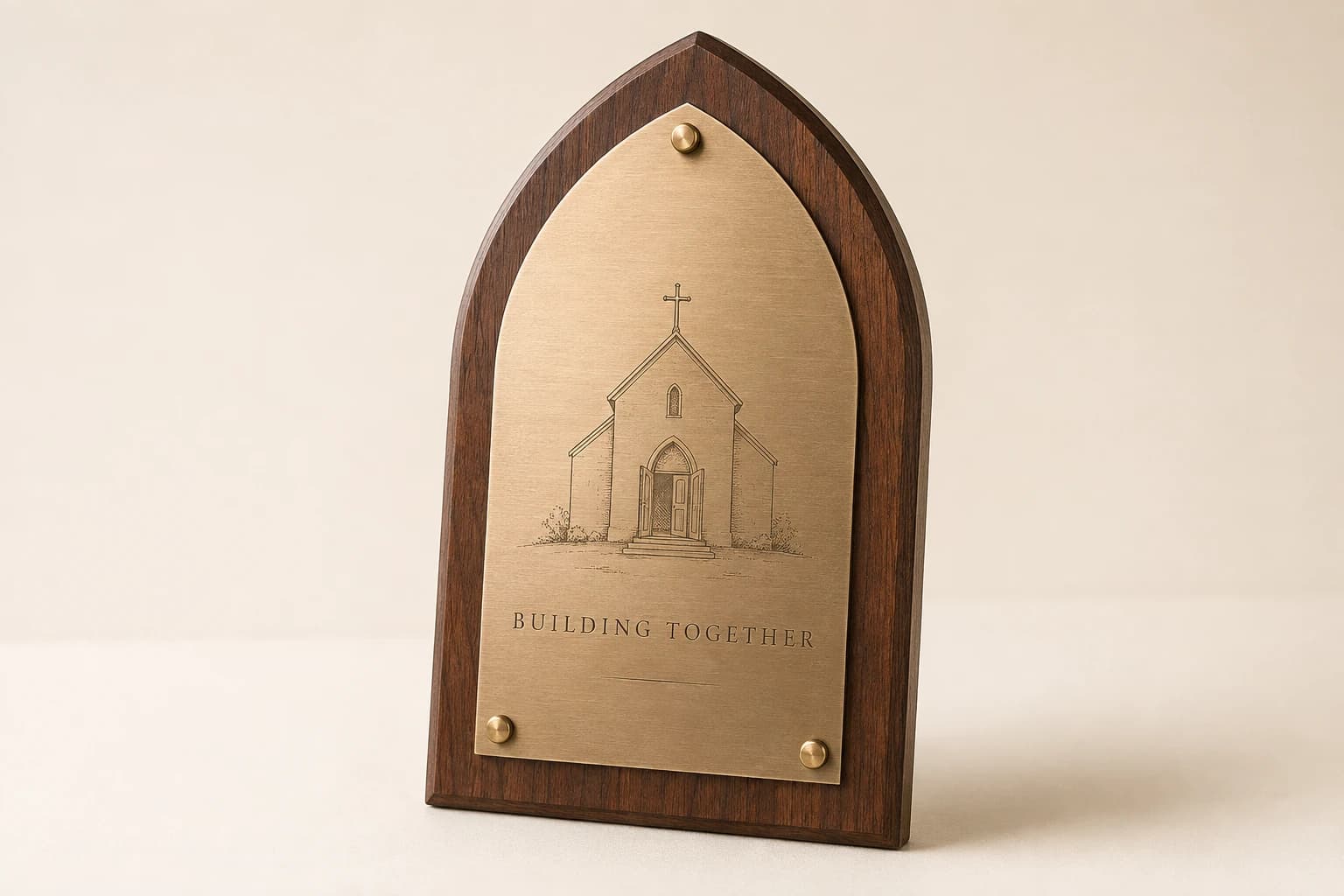
Identify the smallest feature the congregation considers essential and show it in the proposed production artwork at the actual intended size. A window pattern, line drawing or selected emblem can lose meaning if simplified without approval. Ask the supplier to explain any changes needed for the chosen process.
Do not copy another manufacturer’s minimum line sizes into this order as universal rules. A larger plaque or a different image treatment may preserve an approved feature more appropriately than shrinking the remaining dedication. The organizer should distinguish a detail that must remain recognizable from texture that can be simplified. That decision lets the production reviewer return a purposeful interpretation instead of guessing which decorative lines matter most.
When should an emblem be a separate element?
Consider a separately specified emblem when the congregation wants a focal relief that differs from the main inscription treatment. Ask whether it is integral to the plaque or attached as another component, and request the complete construction description. A rendered image can hide the joint between parts or imply that a decorative element is included when it is still optional.
If the emblem comes from the congregation, obtain its approved artwork and resolve any use authority through the responsible reviewer. Keep the inscription area visible in the same proof. The emblem should support the dedication rather than consume so much space that the main name and occasion become difficult to read.
How should finish and contrast be compared?
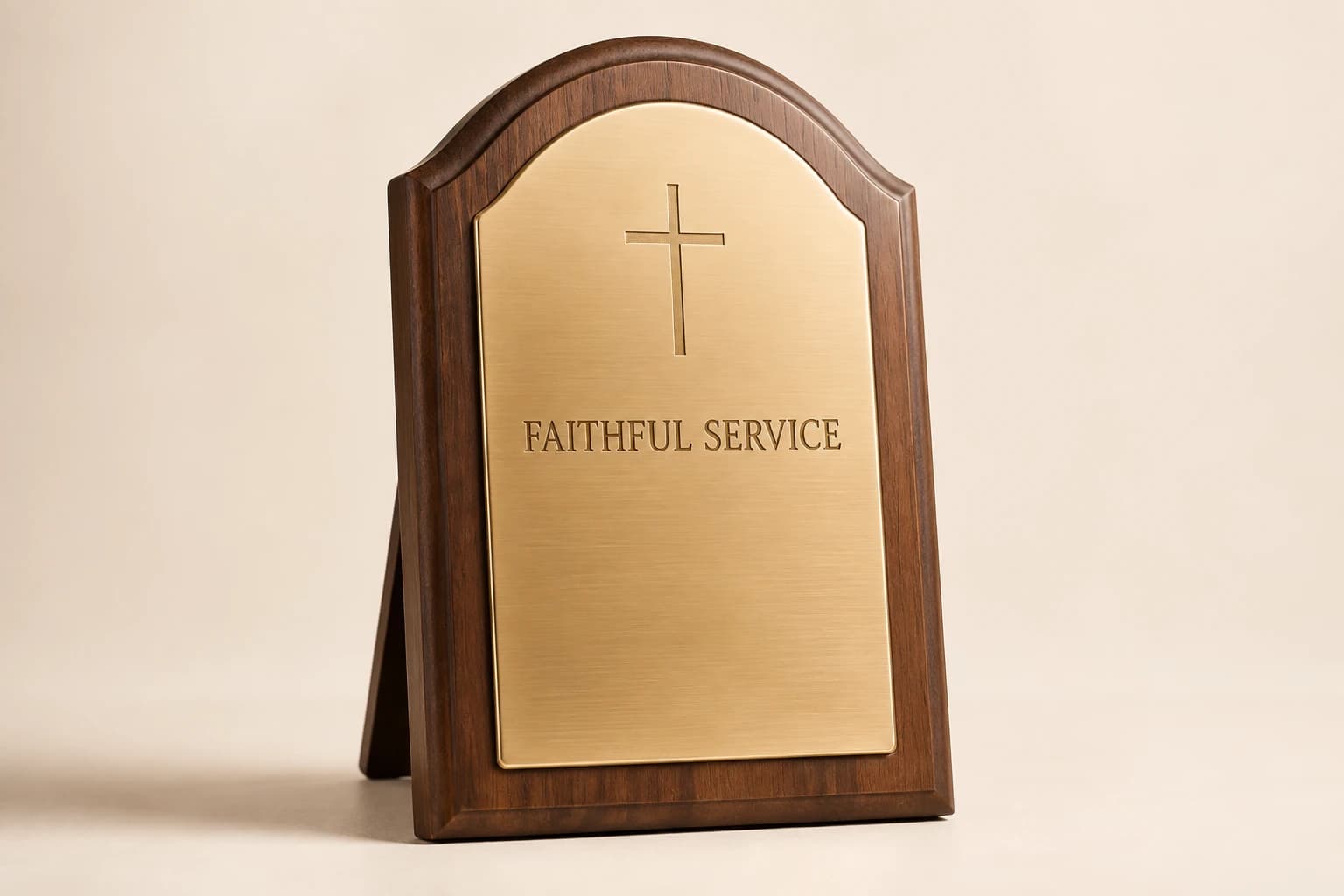
Review the proposed raised and recessed areas with their actual finish descriptions, including where background color or another treatment appears. A polished-looking rendering does not establish how the face will appear beside the church’s wall material or under its lighting.
Ask which sample can resolve the finish decision and whether it represents the proposed metal and process. If the committee has only a general preference for bronze or silver color, describe that as a visual preference rather than an exact alloy specification. Keep the desired appearance, actual material and surface treatment as separate quote fields. Those distinctions make it easier to compare proposals without treating every similarly colored plaque as the same construction.
What belongs in the construction quote?
Request the overall plaque, inscription treatment, emblem construction, finish, edge treatment and supplied attachment components as explicit scope. Ask whether image interpretation, pattern preparation or another design stage is included and what proof the congregation will approve. Installation and site work need their own named responsibility.
No Parish Recognition price range or minimum for this specific dedication construction is established here; obtain those figures against the actual size and design. A cast relief proposal and a flatter engraved proposal should each describe the complete finished object. Comparing only their front-face artwork can conceal different supplied parts and different work still required before the piece can be installed.
Use the article’s example files
Use the worked comparison as a starting point. Replace its hypothetical dimensions and choices with the supplier’s actual proposal and the owner’s approved requirements.
What evidence should settle the selection?
Use evidence that resolves the congregation’s stated priority: a representative relief for depth, a detail proof for an essential line drawing, or a finish sample for the wall relationship. A general catalog image cannot settle all three. Record what each proof demonstrates and which decisions remain open.
If the committee chooses a simpler inscription treatment because it preserves the required detail, retain that reason with the approved design. If relief is essential, request a revised dimensional interpretation rather than accepting missing features silently. The final selection should be explainable as a response to the brief, with the artwork, proposed construction and responsible installation review connected to one release.
How does the illustrative product-selection example work?
In a fictional church design review, the committee requires three features: an approved arch emblem, a clear building name and a fine window outline from an authorized drawing. The first relief concept includes the arch and name but omits the window outline. A flatter concept explicitly includes all three, subject to a real production-detail review.
The comparison therefore records two of three required features in the first concept and three of three in the second. That is a completeness check on hypothetical proposals, not a test of casting or engraving quality. The committee can advance the complete concept or ask the relief designer to resolve the missing outline. It should not approve the first merely because its rendering looks more substantial. The worksheet keeps each required feature separate, marks production proof and site review on hold, and records the actual evidence needed. No depth, minimum line width or material performance is inferred from the three-feature comparison.
Optional calculation: Compare the proposed material descriptions
Which proposed construction fits the intended use?
Compare an integrated relief plaque, a flatter inscription-led face and a mixed construction with a separate emblem by the features each actually supplies. Method names alone do not settle raised or recessed detail. The useful choice preserves the congregation’s essential image and dedication while making finish, component and proof responsibilities explicit.
| Option | Integrated relief direction | Flatter inscription-led direction | Separate relief emblem and inscription |
|---|---|---|---|
| Best reason to choose it | Choose this when the proposed dimensional face is central to the congregation’s approved visual intention. | Choose this when the approved name, dedication and detailed image arrangement should lead the face. | Choose this when the focal emblem and main dedication need different specified treatments. |
| What the buyer must review | Review the actual relief relationships and any simplification of essential emblem or architectural detail. | Review the real engraved or etched treatment rather than assuming every such process has identical depth. | Review the emblem’s attachment, included status and effect on the usable inscription area. |
| What the quote should identify | Identify the metal, integral features, finish and representative depth evidence in the proposal. | Identify text and image methods, finish, edge treatment and production artwork scope. | Identify each component and its finish, plus the complete assembly and site interface. |
What should you confirm before requesting this product?
Ask what the plaque’s actual surfaces and components will be before approving a dimensional-looking rendering. A congregation can value relief, detailed imagery or a clear dedication in different proportions. Confirm the essential features, proof evidence and complete construction quote so the final choice reflects the intended church setting and message.
What affects the cost of cast and engraved dedication proposals?
Request Parish Recognition pricing for the actual size, metal, relief or inscription treatment, image work, finish and supplied components, including the applicable minimum or range. Ask which proof stages and installation responsibilities are included. Different construction routes should be compared as complete objects rather than by a method name or front-face rendering alone.
Can an etched plaque include raised lettering?
Some proposed etched constructions can use raised as well as recessed graphics, so ask about the actual face treatment. Gemini’s product documentation illustrates why the method label is insufficient. The buyer should obtain the selected supplier’s own construction description rather than transfer another manufacturer’s dimensions or production limitations into the order.
Should a fine church drawing be simplified automatically?
Have the congregation identify the essential features and approve the proposed interpretation. A supplier may need changes for a particular process, but the designer should not decide silently that a meaningful window or emblem detail can disappear. Compare another layout or construction if the original treatment cannot represent the approved priority.
Does a relief sample approve the wall installation?
No. It can help the committee judge a surface effect, while the actual plaque size, weight, attachment and wall conditions require their own project-specific review. Keep the responsible installer involved in that interface. A convincing small sample should not be treated as authorization for an unreviewed installation arrangement.
What does the three-feature example establish?
It checks whether hypothetical concepts include the committee’s three required visual features. Two included features leave one unresolved; three included features make the concept complete for that preliminary brief. Neither result proves production detail, durability or fit. Those decisions remain on hold until the actual supplier and responsible site reviewer provide the necessary evidence.
Sources and scope
The sources below support the cited technical details. The ordering workflows are editorial recommendations. Your project specification, price and schedule are established in the written quote and approved proof.
- Gemini: Etched Plaques Product Specifications · checked 2026-09-05
Which buying guide should you read next?
All buying guidesAgree on the purpose, inscription and approval contact before choosing a plaque. Separate a building dedication, donor recognition and personal appreciation message. Confirm names, dates and any quoted passage, then design around the actual display location and the way future additions will be handled.
For worldwide Parish Recognition orders, choose whether scripture or the personal dedication leads the small plaque before arranging the text. Use an approved passage and translation, or a reference-only layout when the full text would crowd the message. Review exact wording, attribution and line breaks together at the proposed physical size.