Parish Recognition · buyer guide
A multi-congregation ceremony order schedule
For worldwide Parish Recognition orders, schedule each congregation’s piece around its actual receiver and presentation role. A host church receiving the main gift does not confirm that visiting congregations’ dedications are ready. Track proof approval, receiving checks and presenter assignment separately, then use the rehearsal as a shared readiness checkpoint.
Reviewed 2026-09-05 · AI-assisted editorial review. General buying guidance; illustrative scenarios are not customer case studies. Images are AI-generated concepts.
A multi-congregation ceremony has several clocks: the approval deadline, the delivery date, the rehearsal and the presentation itself. Begin with the date each finished piece must be in the hands of someone who can inspect and stage it. A host church may receive all objects, or each congregation may bring its own. Record the arrangement per piece rather than assuming the event address is also the delivery address. Ask who can accept packages and where they will be stored before the ceremony. If a congregation arrives only shortly before the event, decide whether its pieces should travel with its representative or reach the host earlier. The schedule should identify a real receiver, not simply a church name and a hopeful arrival date.
How do you create a proof deadline that allows disagreement?
Each congregation may need a different internal review process. Ask its representative when the name, attribution and dedication can be approved, then allow time for the final coordinator to reconcile shared elements. A common ceremony does not mean every group will be ready on the same day.
Separate items that can proceed independently from a joint piece that requires all named groups to agree. Do not release the shared inscription while one congregation’s approval is still pending. If a late correction affects only a companion piece, identify that limited scope so it does not unnecessarily restart every proof. Use revision numbers and one final release list. The schedule should make it clear which proof is approved, which is awaiting a response and who is responsible for the next decision.


How do you separate manufacturing batches from ceremony order?
Production may group similar materials or repeated layouts, while the ceremony follows speakers, ministries or congregation order. Give each finished object an identifier that connects those two arrangements. Add the planned presentation segment and the person who will carry it to the stage.
A packing list organized only by product type may leave volunteers searching through several boxes during the event. Request ceremony grouping if it is needed and confirm the supplier’s proposed packing scope. Keep a separate stage list that uses familiar names and a short description of the object. If a piece is shared by several congregations, identify the lead presenter and the person who takes custody afterward. This avoids treating a joint presentation as an unplanned negotiation about who should hold or keep the gift.
How do you build a receiving window before the final rehearsal?
Set aside time to open packages, compare inscriptions with the approved proofs and organize any onward transfer. The ceremony date should not be the first opportunity to discover a missing stand, an incorrect congregation name or a damaged component. Ask the receiver to record exceptions promptly with the relevant proof and item identifier.
The size of the receiving allowance depends on the actual event and confirmed order arrangements; this guide does not prescribe a universal number of days. If the planned arrival leaves no meaningful inspection opportunity, have the organizers consider a revised handoff plan rather than quietly accepting an impossible correction window. Keep any replacement or later-presentation decision with the event owner so volunteers do not make conflicting promises while trying to solve the same problem.
UPS advises placing a duplicate address label inside a package.


Sources: UPS: How to Pack Your Shipments
How do you plan absent presenters and changed destinations?
Write a simple fallback for a congregation whose representative cannot attend. The host may present on its behalf if authorized, hold the object for later collection or arrange an approved onward shipment. Those choices affect the stage script and the final ownership record, so decide them together.
If the recipient’s destination changes, confirm the new receiving contact before forwarding the object. A church office address may be suitable for a daytime delivery but inappropriate for a private family keepsake after retirement. Keep personal addresses in the restricted delivery record, not the public ceremony worksheet. Where international transport is involved, obtain current advice for the actual packed contents, service and destination. Do not assume that a domestic delivery estimate extends to the final family handoff abroad.
Schedule the host congregation’s main gift
Load the fictional example, then replace its inputs with the reviewed details for your project.
Method: Subtract the entered receiving, transit, production and proof allowances backwards from the required arrival date, excluding weekends. Holidays, available capacity and carrier commitments require separate confirmation.
Build your plan
Work backwards from arrival using your entered stage durations. Weekends are skipped; holidays and closures require extra allowance. Dates describe a plan, not reserved production capacity.
Use the article’s example files
Sample rows are illustrative and are not production instructions. Replace their assumptions, keep private records separately and complete the approval fields before using the sheet for a real order.
How do you close the schedule with a confirmed owner?
After the ceremony, reconcile every item against its intended destination. Record which pieces were presented, which remain with the host and which are awaiting collection or onward shipping. A successful stage moment does not necessarily mean the gift reached its permanent owner; objects can be left behind after photographs or returned to a storage box by a helpful volunteer.
Assign one person to close those remaining rows. Save the final proof and destination record for any later copy or replacement request. If a congregation asks for an additional piece after the event, clarify whether it is a historical copy or a new dedication with a different presenter line. The original schedule then remains an accurate record of the ceremony rather than an ever-changing list that obscures what was actually handed over.
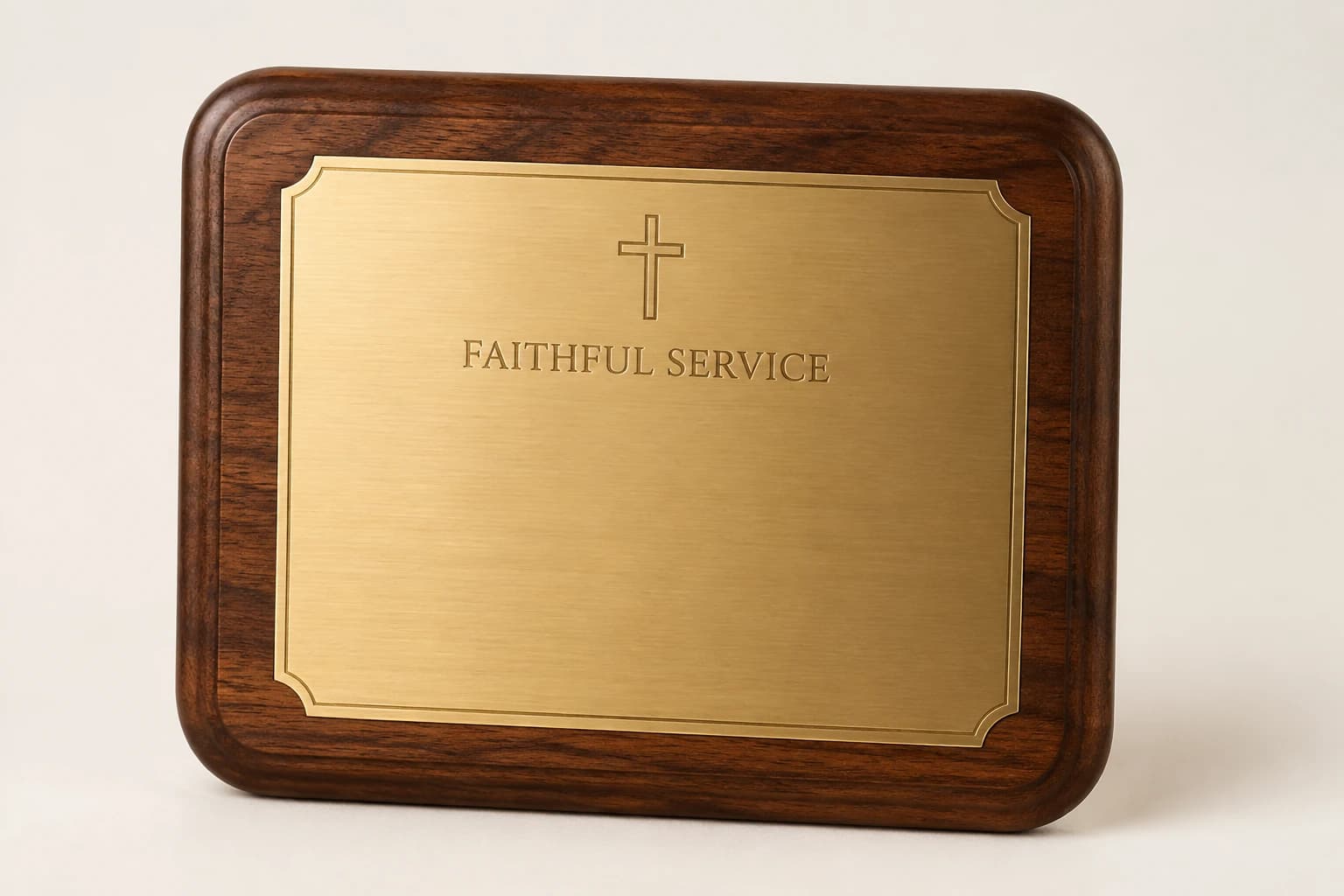
How do you give the host a compact ceremony control sheet?
Prepare a separate host sheet containing only the item identifier, congregation, presentation segment, presenter and final custodian. Keep shipping addresses and private proof notes in their appropriate records. At rehearsal, walk through the sheet in presentation order and confirm that the actual objects can be found.
If a presenter changes, update that field without changing the approved engraving. If the object’s intended owner changes, pause and confirm whether its dedication still makes sense. These are different kinds of changes and should not be handled as interchangeable event edits. After the final photograph, the custodian column becomes especially useful: someone should know whether the plaque returns to its protective package, travels with the recipient or remains with the host. A ceremony volunteer should not have to infer ownership from whichever person happened to be holding the object when the stage cleared. The sheet makes the last few minutes of the event part of the planned handoff.
How does this illustrative receiving schedule work?
In a fictional joint service, the host congregation agrees to receive the main gift while two visiting congregations bring their own dedications. The coordinator creates three item rows with distinct receiving contacts and a shared rehearsal checkpoint. The main gift uses the illustrative timeline below; the visiting pieces require their own confirmed dates.
The host marks the event ready only after all three objects are checked and assigned to presenters, rather than assuming one delivered package means the whole ceremony order is complete. Assume a fictional required arrival of Friday, October 30, 2026. Enter two business days for receiving, four for transit, five for production and three for proof review. Counting backwards across weekdays gives October 28 for the start of receiving allowance, October 22 for dispatch, October 15 for production and October 12 for beginning proof review. These are entered assumptions for arithmetic practice. They are not quoted durations, reserved capacity or a promise that a carrier or workshop operates on every weekday in this example.
Central receiving at the host church or Congregation-level receiving: which fits the intended recognition?
Central receiving gives the host one place to inspect and stage the ceremony pieces. Congregation-level receiving lets each group manage its own delivery before the shared handoff. Compare who can check the actual objects and resolve exceptions in time; neither approach makes one package’s arrival proof that every dedication is ready.
| Option | Central receiving at the host church | Congregation-level receiving |
|---|---|---|
| Best reason to choose it | Use this when one team can inspect, store and stage all pieces before the ceremony. | Use this when local representatives need to inspect or prepare their pieces before traveling to the event. |
| Main review question | Can the host accept the shipments and reconcile each congregation’s objects and proofs before rehearsal? | Who confirms each piece is correct and physically present before the ceremony begins? |
| What to specify | Specify one receiving contact, item-level congregation identifiers and a ceremony sequence separate from shipping batches. | Specify separate receiving contacts, travel handoffs and a host check-in record for all objects arriving with presenters. |
| Later change | The host records each visiting object’s actual readiness instead of extending the main gift’s delivery status to the whole ceremony. | Each congregation retains its own receiving responsibility until its piece reaches the agreed host or presenter handoff. |
What should the organizer confirm before ordering?
Confirm each congregation’s approval owner, receiver and presenter against the shared rehearsal checkpoint. The main gift and visiting dedications can have different production routes. A useful ceremony schedule shows which objects are actually ready, who handles an absent presenter and which handoffs remain open after the host’s first delivery.
How early should a multi-congregation order be scheduled?
Build the Parish Recognition plan backward from the receiving and rehearsal dates using confirmed proof, production and transit allowances. Ask the quote to state its applicable minimum, complete piece scope and shipping arrangement. Different congregations can have different approval dependencies, so one shared deadline is useful only when each group can meet it.
Can every congregation use the same proof cutoff?
A common cutoff can work when each group has an identified reviewer and enough time to resolve its wording. Record separate held fields when approvals differ. Do not treat the fastest congregation’s response as authorization for everyone’s dedication; the coordinator should know exactly which piece is ready and which decision still prevents release.
Should the production batch follow the speaking order?
Production may group similar constructions, while the ceremony may group presenters or dedications. Keep a stable item reference connecting the proof, packing row and presentation segment. Ask for the desired grouping explicitly, and prepare a host control sheet so the next object can be found without opening and reading every plaque.
What if a visiting presenter cannot attend?
Name an alternate presenter or later handoff owner without changing the approved inscription automatically. The object’s intended recipient and owning congregation may remain the same even when the speaker changes. Update the ceremony control sheet and communicate the new physical handoff through the coordinator so the piece does not lose its destination backstage.
Does the October timeline cover every visiting piece?
No. The illustrative backward calculation applies to the main gift’s entered receiving plan. Visiting congregations’ pieces need their own confirmed production and delivery arrangements. The host should reconcile all item rows at the shared readiness checkpoint instead of extending one calculator result to separate objects whose approvals or shipping routes have not been checked.
Sources and scope
The sources below support the cited technical details. The ordering workflows are editorial recommendations. Your project specification, price and schedule are established in the written quote and approved proof.
- UPS: How to Pack Your Shipments · checked 2026-09-05
Which buying guide should you read next?
All buying guidesFor worldwide Parish Recognition orders, choose one joint congregation gift when the intended recipient should own one shared object. Choose separate dedications when different owners or destinations need their own pieces. Agree on ownership and the common message before turning the number of contributing congregations into a physical plaque count.
For worldwide Parish Recognition orders, keep pastoral retirement and volunteer recognition as distinct message groups within the ceremony. Count the actual approved pieces after reviewing people who appear in several ministries. A shared order can coordinate delivery while preserving the retirement dedication, volunteer wording and intended owner of every object.